Affiliate disclosure: This post contains affiliate links. If you buy through them, I earn a small commission at no extra cost to you. I only recommend knives I’d actually put in my own kitchen.
The problem: generic knife gift guides miss what actually matters to a Japan-culture enthusiast
Our general gift guide covers broad appeal — knives most recipients will like regardless of their specific interests. But if you’re buying for someone who’s genuinely into Japanese culture — not just cooking, but the history, craftsmanship, and tradition behind it — a generic “prettiest knife” recommendation misses the point entirely.
In my experience, this specific type of recipient values provenance and story as much as, sometimes more than, raw performance or visual flash — which changes the calculus significantly from a standard gift guide.
Who this article is NOT for
- Buying for someone with no particular interest in Japanese culture, just a cooking enthusiast. Our general gift guide with the Shun Classic or Miyabi is a better fit there.
- Buying for a professional chef. They’ll have specific technical preferences that outweigh cultural narrative — see our professional guide instead.
- Extremely tight budgets. Genuine culturally-significant options here mostly start around $190.
Selection criteria (3 points)
1. Traceable regional and craft provenance. For this recipient, knowing the knife comes from a real, specific tradition — like a centuries-old Sakai blacksmithing lineage or a long-established Tokyo cutlery house — matters more than a generically “Japanese-styled” product with no real story behind it.
2. Presentation that reflects the tradition, not just generic gift packaging. Traditional wooden saya (sheaths), wa-handles, and packaging that reflects genuine Japanese craft aesthetics resonate more with this recipient than standard retail boxing.
3. An accompanying story or context you can share. Because this recipient values understanding, gifting alongside a bit of context — the maker’s history, what wabocho means, the tradition behind the specific piece — adds meaning a knife alone doesn’t convey.
Comparison table
| Yoshihiro VG10 Gyuto (wa-handle) | MASAMOTO MV Santoku (wa-handle) | Miyabi Birchwood (for comparison) | |
|---|---|---|---|
| Provenance | Traditional Japanese hand-forging | Historic Tokyo cutlery house, favored by professional sushi chefs | Modern manufacturing, Japanese-designed |
| Presentation | Traditional Octagonal Shitan rosewood wa-handle | Traditional wa-handle (Wa Wood Handle), classic santoku shape | Premium retail packaging, hammered Damascus |
| Price | $189.99 | $199.80 | $325–450 |
| Best for | Recipients valuing authentic heritage | Vegetable-focused cooks who love Japanese craft | Recipients who prioritize visual “wow factor” |
Individual reviews
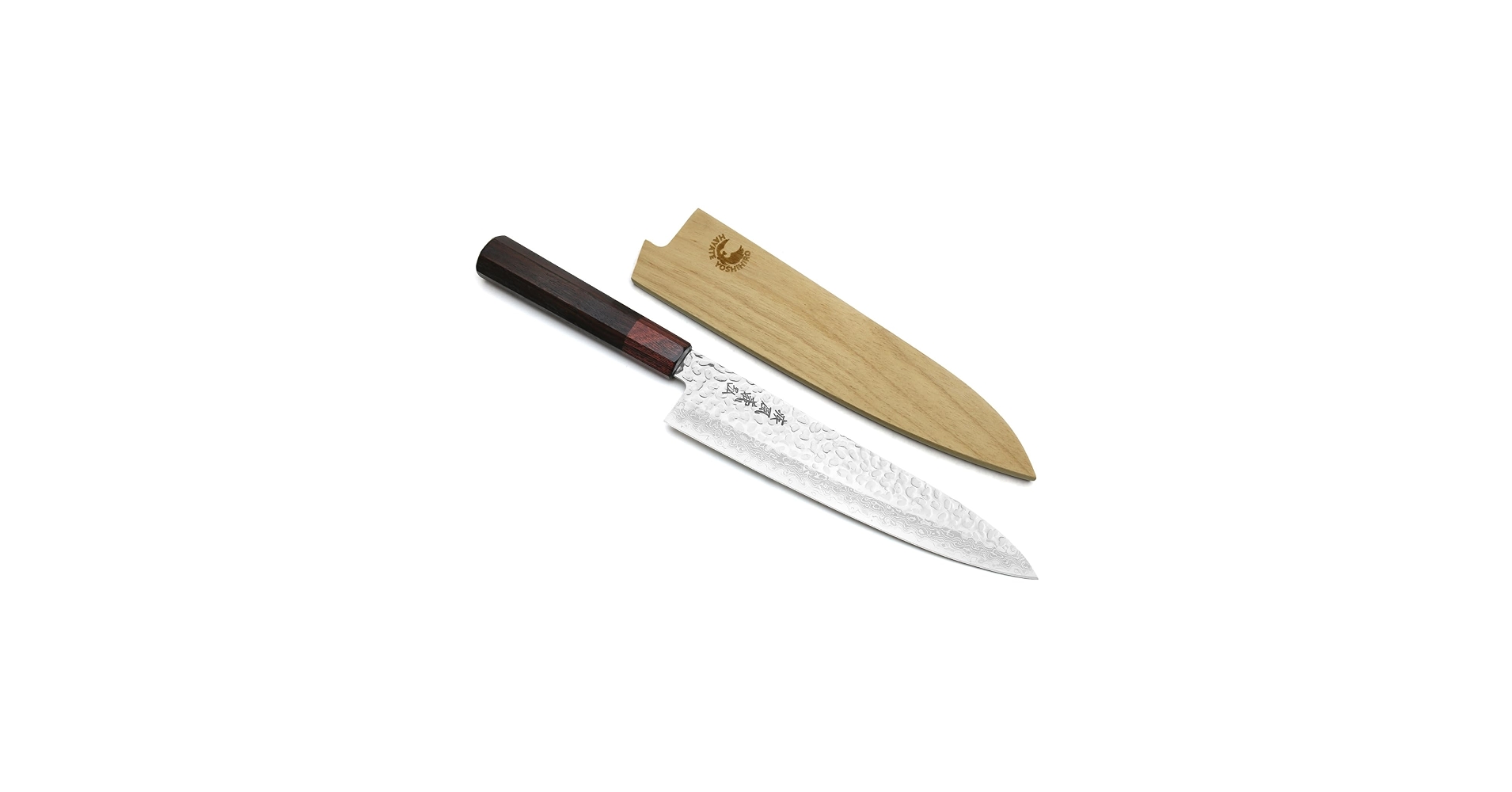
Yoshihiro VG10 46-Layer Hammered Damascus Gyuto (wa-handle)
For a recipient who genuinely appreciates Japanese culture, gifting a wa-handled Yoshihiro gyuto offers something a mass-manufactured knife simply can’t — a traditional octagonal Shitan rosewood handle paired with hand-forged 46-layer Damascus construction, in a shape versatile enough to become their daily-use knife.
Pros:
- Genuine traditional wa-handle (Octagonal Shitan rosewood), not a Western-style substitute
- Hand-forged 46-layer Damascus construction gives it real visual and craft presence
- Versatile gyuto shape ensures it gets used regularly, not just displayed
Cons:
- Wa-handle requires some adjustment if the recipient is used to Western handles
- Damascus patterning adds cost compared to a plain-finish equivalent
- Requires explaining the significance for full appreciation

MASAMOTO MV Santoku (wa-handle)
If the recipient’s cooking leans vegetable-focused, the MASAMOTO santoku delivers genuine wa-handle heritage from one of Tokyo’s most respected cutlery houses, in a shape that’s slightly easier to adopt for someone newer to traditional Japanese knife handling.
Pros:
- Genuine wa-handle from a long-established, well-regarded Japanese cutlery maker
- Slightly more accessible price than the gyuto
- Well-suited to a recipient who cooks a lot of vegetable-forward Japanese food
Cons:
- Less versatile than a gyuto for varied protein-heavy cooking
- Still benefits from context/explanation to be fully appreciated
- Wa-handle adjustment period applies here too


Recommendation by use case
- Recipient loves Japanese culture broadly and cooks varied meals: Yoshihiro VG10 Gyuto (wa-handle).
- Recipient is into Japanese cuisine specifically, especially vegetable-forward dishes: MASAMOTO MV Santoku (wa-handle).
- Recipient prioritizes visual impact over cultural narrative specifically: Miyabi Birchwood — see our general gift guide.
- Want to add extra meaning to the gift: Pair the knife with a bit of context about Japanese blacksmithing tradition — our history of Sakai bladesmithing piece is a good primer on the craft’s roots, even for a knife from a different region or maker.
Conclusion
For someone who loves Japanese culture, the “best” gift knife isn’t necessarily the most visually striking one — it’s the one with real, traditional craftsmanship behind it, right down to details like an authentic wa-handle. In my experience, recipients like this remember and value the context as much as the object itself, which is exactly what a genuinely wa-handled, hand-forged piece offers over a generic “Japanese-style” knife.
Ready to choose a meaningful gift? Compare current pricing on the Yoshihiro gyuto and MASAMOTO santoku (both genuine wa-handle) using the links above, or see our general gift guide if cultural provenance isn’t the primary factor for your recipient.
コメント