Affiliate disclosure: This post contains affiliate links. If you buy through them, I earn a small commission at no extra cost to you. I only recommend knives I’d actually put in my own kitchen.
The problem: general comparisons don’t answer your specific question
Most santoku vs gyuto articles try to cover every use case at once — meat, fish, herbs, vegetables — and end up giving you a vague “it depends” answer. If your cooking is genuinely vegetable-heavy — big batches of mirepoix, stir-fry prep, salads, roasted veg trays — the general comparison doesn’t tell you what you actually need to know.
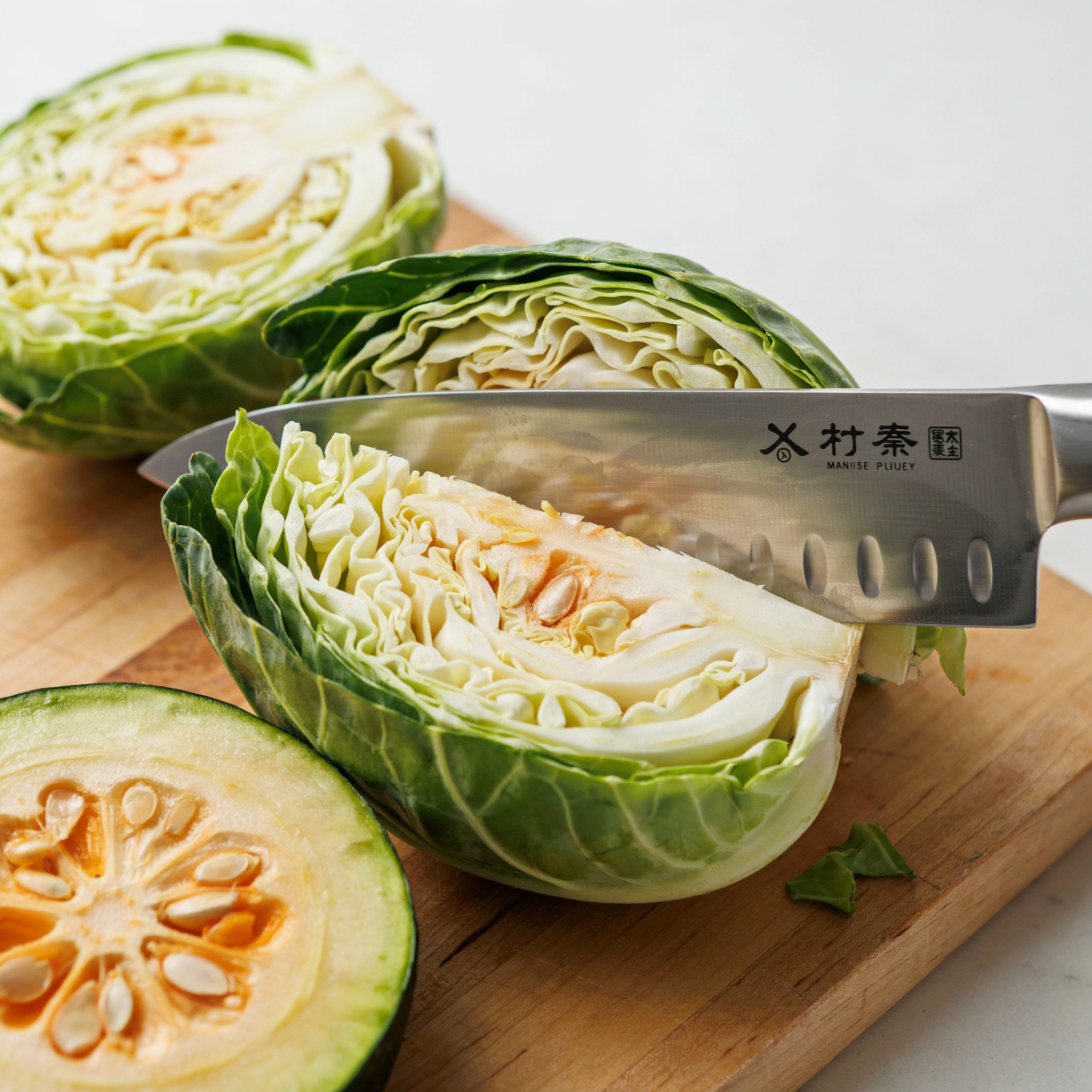
In my experience, vegetable prep is where the santoku-vs-gyuto difference is most obvious, because the cutting motion difference translates directly into speed and control on hard, round, or awkwardly-shaped produce.
Who this article is NOT for
- Cooks who mainly prep meat and fish. The gyuto wins by a wide margin there regardless — see our gyuto for meat and fish guide instead.
- Anyone who’s already comfortable with a specific shape. If your santoku or gyuto already works for your vegetable prep, this won’t change your mind, nor should it.
- Professional prep cooks doing industrial-scale veg prep. At that volume, a nakiri (a dedicated vegetable knife) is a more relevant comparison than either of these.
Selection criteria (3 points)
1. Flat edge contact with the board. Santokus have a flatter edge profile than gyutos, which matters enormously for push-cutting through something like a large potato or squash — more of the blade contacts the board at once, meaning fewer strokes to get through.
2. Tip usefulness for irregular produce. Gyutos’ pointed tip is genuinely useful for things like coring tomatoes, trimming awkward vegetable shapes, or working around a squash’s stem — tasks where a santoku’s rounded tip is slightly less precise.
3. Blade height for the “claw grip.” Taller blade profiles (santokus tend to run slightly taller relative to their length) give more knuckle clearance when using a claw grip on rounded vegetables like onions, which matters for both speed and safety.
Comparison table
| Santoku | Gyuto | |
|---|---|---|
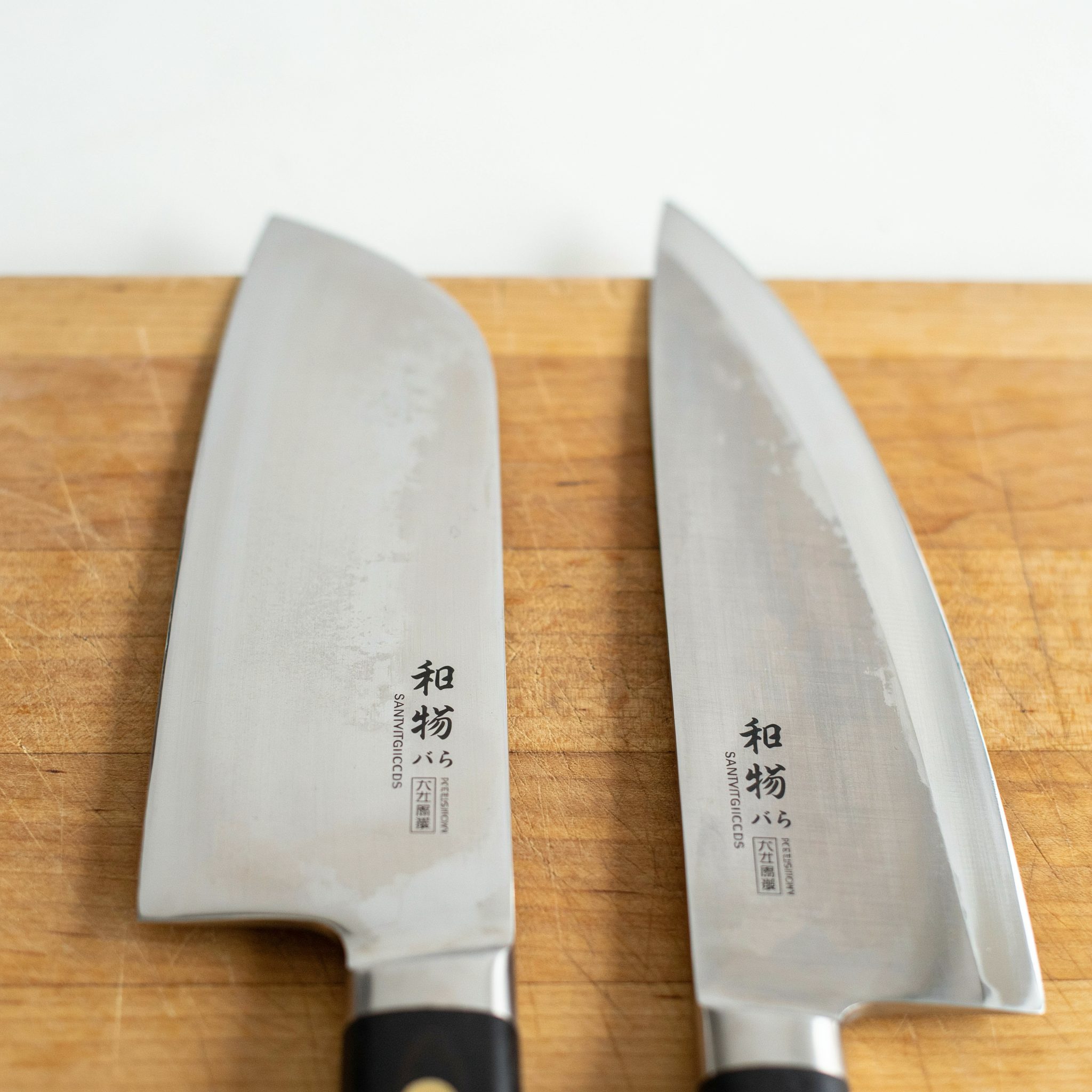
| Edge profile | Flatter, more board contact | Curved, rocking motion |
| Best for | Dense, round vegetables (squash, cabbage) | Irregular shapes needing tip control (tomatoes, peppers) |
| Speed on bulk chopping | Faster for repetitive straight cuts | Slightly slower but more versatile |
| Example (this niche) | Misono UX10 Santoku | Tojiro DP Gyuto |
Individual reviews
Misono UX10 Santoku
For vegetable-forward cooking, the UX10’s thin grind is the standout feature — it genuinely reduces the resistance you feel pushing through something dense like a butternut squash, where a thicker blade would need real force.
Pros:
- Minimal resistance through dense, round vegetables
- Flatter profile suits repetitive straight-down chopping
- Compact size, easy to control at speed
Cons:
- Rounded tip less ideal for coring or detail trimming
- Premium price for what’s arguably a specialist strength
- Not the best choice if your prep also includes a lot of meat


Tojiro DP Gyuto
Even for vegetable-heavy cooks, the gyuto’s pointed tip earns its keep on the awkward stuff — coring a tomato cleanly, trimming a pepper’s stem, or working around a squash’s tougher core.
Pros:
- Pointed tip handles irregular produce shapes well
- More versatile if your prep occasionally includes meat or fish too
- Excellent value for the steel quality
Cons:
- Curved edge means slightly less flat contact on straight cuts
- Longer blade needs a bit more confidence to control
- Basic handle, no aesthetic flourish


Recommendation by use case
- Mostly dense, round vegetables — squash, cabbage, potatoes: Santoku wins clearly here.
- Mixed produce with lots of irregular shapes — tomatoes, peppers, herbs: Gyuto’s tip control is the more useful feature.
- You batch-chop the same vegetable repeatedly (e.g., meal prepping): Santoku’s flatter edge speeds up repetitive straight cuts.
- Your prep occasionally crosses into meat or fish too: Gyuto, for the added versatility.
Conclusion
For vegetables specifically, the honest answer leans toward “it depends on which vegetables” more than most articles admit. In my experience, a santoku wins for dense, round produce prepped in bulk, while a gyuto’s tip earns its place on anything irregularly shaped. If you genuinely only ever cook vegetables and never touch meat or fish, the santoku is probably the better single purchase.
Ready to decide? Compare current pricing on the Misono UX10 Santoku and Tojiro DP Gyuto using the links above. For the full general comparison beyond vegetables, see our santoku vs gyuto guide.
コメント